Showing posts with label vegetables. Show all posts

Tuesday, 6 January 2015

Quick-friend Coconut Beans and Carrots

Nom, at last a vegetable-based Indian side dish that I can make in just under 10 minutes! Stein suggests using fresh or frozen grated coconut, but I find that adding dried shredded coconut just a minute before the cooking time is up soaks up the remaining water, and is a lot less hassle to keep in the cupboard. You could easily vary the vegetables based on whatever you have to hand, and the spices to complement whatever else you're cooking.

Ingredients

  • vegetable oil
  • 2 small chillies, finely chopped (keep the seeds if you like the spice)
  • handful of curry leaves (fresh or dried)
  • 1 tsp black mustard seeds
  • 1 tsp cumin seeds
  • 1/2 tsp coriander seeds
  • large handful of green beans, topped, tailed and diced
  • one medium to large carrot, diced
  • 1/2 tsp salt
  • 75 ml water
  • a large handful of dried shredded coconut

Bruise the spices in at mortar and pestle then fry with the curry leaves and chillies in a frying pan for a minute. Tip in the vegetables and salt, stir to coat, then add the water and immediately cover, turning the heat down to a simmer. Cook for 5-6 minutes, until the vegetables are just done, then add the coconut, stir, and re-cover, turning off the heat so the coconut can absorb the cooking water.

Thursday, 17 May 2012

Salt n Pepper Tofu Stir Fry

To go with our vegetarian steaks, we made a quick stir fry. The tofu was salted and peppered and fried separately, then left to drain. We finely chopped the vegetables and about half a thumb of ginger, stir-fried them quickly for a few minutes, then added the tofu and a splash of soy sauce at the end. Nom.

Thursday, 8 March 2012

Sweet and Sour Fish Tempura

This morning I went via the supermarket to stock up on supplies for my gliding trip tomorrow. On the way out I popped into the fishmonger and got some lovely little white fish fillets. (I wish I could remember what they were, but it was one of these Southern Hemisphere fish and I haven't memorised them all yet!) They were small anyway, and sweet and fresh. I was daydreaming about how to prepare them and had a strong craving for my sweet and sour sauce. So I figured we could follow the same recipe, but tempura the fish instead of stir-frying it, as it was so delicate and fragile.

Super-husband made all the sauce, set the deep-fryer up, egg-fried the rice and stir-fried the vegetables while I was out Zumba-ing, then I came home and whisked up this batter in a couple of minutes, dunked the fish, and they took just minutes in the fryer. On removal, the batter was crisp and light, and the fish tender and steaming hot, cooked to perfection. Some of the bottom ones did stick to the mesh, I need to work on that... but it did give us an excuse to eat some of the broken ones fresh out of the fryer, tossing them from hand to hand to cool them fast enough to eat. I tried out a new batter today, with a few more additions compared to my usual super-simple version. It was excellent - maybe a tad lighter and crisper!

Ingredients

  • one egg white
  • 1/4 cup of plain white flour
  • 1/4 cup of white rice flour
  • 1/2 tsp sugar
  • 1/2 cup of ice-cold water
  • 300g fish fillets, descaled, deboned

Fill your deep fryer and set it to 180 C. If your fillets are thicker than 1cm, slice them widthwise into thinner pieces. In a medium bowl, whisk the egg white by hand until somewhere between frothy and just beginning to go white and form peaks. Put the flours and sugar in a large bowl, and pour in all of the water and the egg white. Stir everything together for maximum one minute, stopping as soon as you see no more visible powdery flour. Lumps are fine.

Lower the basket in the fryer into the oil. Dip each piece of fish into the batter, lift out, let drip of excess and then drop gently into the hot oil, using tongs if necessary. Close the lid and deep-fry for 4 minutes; lift the basket and check. The tempura should just be going a tiny bit gold, and the fish will be cooked through. Pop onto a plate with some paper towel; if you are making many batches, try to serve out as quickly as possible.

Tuesday, 10 January 2012

Roast Aubergine Wedges

It's too hot to eat 'properly'. I just want sliced vegetables, dipped in hummus and duqqa. But I also want aubergines, roasted and meltingly soft. So - I made some - just sliced a very large aubergine into edges, tossed them in olive oil, ground black pepper and ground coriander, then roasted them for fifty minutes at 200 C, until caramelised and delicious. In future I'll need to make these on the barbeque, so as to avoid heating the house by running the oven... a new antipodean challenge!

Tuesday, 29 November 2011

Winter Slaw with Rare Roast Lamb and Red Pepper Quinoa

Butchers here tend to offer a good selection of marinaded and prepared meats which are ready to roast, fry or bbq. We picked up a rolled loin of lamb with a layer of spices and a small amount of spiced stuffing. It was quite delicious - roasted for 50 minutes at 200 C until golden on the outside and still pink on the inside, then rested for 10 minutes before being sliced thinly. I took the opportunity of the umami flavours spicy, smoky meat  to make a light, crunchy slaw, based on the advice in Nigel Slater's Tender. Carbs came in the form of some seasoned quinoa stirred through with roast peppers left over from a previous meal.

Ingredients:
  • one small carrot or half a large
  • one quarter of a white cabbage
  • a stick of celery, or a generous handful of its leaves
  • a small handful of flat-leaf parsley or dill
  • 4 tbsp natural yoghurt
  • 2 tbsp olive oil
  • 1 tbsp lemon juice
  • a generous handful of green pumpkin seeds

Peel the carrot but leave the end on, then grate it into long thin shreds. Finely shred the cabbage and thinly slice the celery (or its leaves). Finely chop the herbs. Combine the yoghurt, olive oil and lemon juice together, and season well, then stir through the vegetables. Toast the pumpkin seeds either in an oven at 200C for 5-6 minutes, or by dry-frying them over a medium heat in a non-stick frying pan. Serve the slaw with pumpkin seeds scattered over.

Sunday, 25 September 2011

Dolsot Bibimbap

This is one of my favourite Korean dishes, which I discovered at a brilliant Korean restaurant in Cambridge, Little Seoul. The basic ingredients are white rice, an egg, and a mixture of stir-fried vegetables and meat, and it's best served with the traditional kimchi.The trick to the meal is that for each person, you heat their very own stone or clay pot in the oven, then add the ingredients at the last minute and bring it sizzling to the table. The egg should be fried sunny-side, or even dropped in raw at the last second, so that each person can break it into the rice and cook it to their own liking. It's delicious and really interactive.

From the moment I tried it, I wanted to make it at home, but I waited until the move to Australia was over to go out and buy the pots - the less we had to move, the better! Tonight I went for a really simple version since it was my first time preparing it. Surprisingly, it only took about half an hour to prepare - just like a stir fry really, but with the added fun of the hot pot.

Ingredients

  • two clay or stone pots, from your local Asian supermarket
  • 200-300g white rice, depending on how hungry you are!
  • 200-300g eye fillet or other good cut of beef
  • 4 cloves garlic
  • 1 carrot
  • 4 thin spring onions
  • 2 tbsp sesame oil
  • 2 tbsp brown sugar
  • 1 tbsp rice wine
  • 1 tbsp soy sauce
  • 2 eggs

Put the pots in the oven and set it to 220C. Cook the white rice at a simmer with a 2:1 ratio of water to rice; it should take about ten minutes. Finely slice the beef into wide, flat pieces, then stir fry in a hot wok until just cooked, then remove to a bowl (without paper). Finely mince the garlic and finely slice the spring onions. Cut the carrot in half lengthways and cut thin, flat, diagonal slices from it. Stir fry the vegetables together for a couple of minutes, until cooked but still crisp. Return the beef to the pan, along with the oil, sugar, wine and soy sauce and allow to bubble through for a minute or two. Fry the two eggs sunny-side up, while you ladle rice and the cooked meat and vegetables into the pots. Add the eggs at the last second then serve immediately with kimchi, sweet chilli sauce and soy sauce.

Sunday, 26 June 2011

Chinese Broth and Dumplings

Still running down the freezer - including a lovely pack of mixed dumplings I picked up from the Chinese supermarket an unspeakably long time ago. Luckily they steam right back to life, and go very well with a quick vegetable broth that simmers as we go for a walk. With a batch of quickly stir-fried vegetables it makes a light yet nourishing weekday meal. The trick is to have everything ready before you begin to stir-fry the vegetables, and to make sure they do not overcook; they should still have some bite and taste green, never soggy.

Ingredients:
For the vegetable stock:

  • 1 carrot, topped, tailed and scrubbed
  • 1 onion, peeled and halved
  • 2 sticks of celery
  • 2 bay leaves
  • 1 stick of lemongrass
  • a thumb-sized piece of ginger
  • a dried chilli
  • a handful of coriander stems

For the stir-fried vegetables:
  • half a head of broccoli
  • two handfuls of sugar-snap peas
  • 2-3 spring onions
  • 2 cloves of garlic

To finish:
  • 8-12 dumplings, steamed according to the packet instructions
  • coriander leaves
  • lemon wedges
  • soy sauce

Put all of the stock ingredients in a saucepan and cover with boiling water; bring to a boil and then simmer for at least an hour. Meanwhile, finely slice the broccoli and cut the sugar-snap peas and spring onions into long strips. Five minutes before the dumplings are done, heat some vegetable oil in a wok and throw in the broccoli, tossing it about for a few minutes. Add the sugar snap peas and spring onions, toss for a further minute, then crush in the garlic and stir-fry for a further two minutes.

Drain the stock into the wok (or into another bowl first, if you dislike enormous clouds of steam), and slosh over a good few tsbp of soy sauce (depending on its strength). Serve the broth and vegetables into bowls and top with the dumplings and coriander leaves. Bring to the table with lemon wedges and soy sauce on the side so that people can lighten and salt the broth to their taste.

Wednesday, 22 June 2011

Stuffed Marrow

Sorry about the lack of updates for the last week; I was busy with work and my parents drove down to help with the wedding planning. We had a trip to the florists, where I learned there are worse things than buying shoes, and on a more fun note we had the wine-tasting for the wedding! Nine bottles between nine people, and we picked out a champagne, a white and a red. Oddly enough, the cheapest of each, but we really were tasting for quality!

Also I had my hen party at the weekend, which was brilliant - thank you to all the lovely ladies who made it possible! This also involved some amazing food - lovely picnics, oysters on ice, a seared beef fillet with foie gras, the choclatiest-thing-on-the-menu, a brilliant Mexican-inspired veggie breakfast and afternoon tea with champagne! A lot to fit into one weekend and certainly more than I can properly describe in one blog post. Especially when I need to catch up with lots of food I cooked myself...

As I was away all weekend, the SO did all the shopping and food planning. So this week is a little... interesting. Ok, ok, I bought this marrow, so to be fair he did plan around using it up. But as my dad predicted, it's tough coming up with something when you're faced with a big green tasteless vegetable. They just look so lovely on the market stall! Fair play to the SO, he found a good flavourful recipe, and after a couple adjustments by yours truly, I think it turned out very well. This would be brilliant with a generous dollop of split pea dahl on the side, but at the time I didn't realise so just had some fruit afterwards. The ingredients bear a startling resemblance to one of my favourite pasta fallbacks, so I guess some flavour combinations are simply classic.

Ingredients:
  • 125g bulgur wheat
  • one red onion
  • three cloves of garlic
  • 100g spicy chorizo
  • a large marrow
  • two red peppers, roasted and skins removed
  • two ripe red tomatoes
  • a large handful of coriander
  • a large handful of mint
  • a large handful of parsley
  • juice of one lemon

Preheat the oven to 200 C. Set the bulgur wheat cooking according to its cooking instructions - mine takes 15 minutes in simmering water at a 3:1 water:wheat ratio. Finely slice the red onion and gently fry it for 4-5 minutes until softened. Finely dice the chorizo and add it to the pan, then crush in the garlic and  cook for a further minute.

Marrows: not completely useless.
Slice the marrow lengthwise and scoop out the seeds, erring on the side of scooping out more marrow rather than less. Discard these scoopings - or let me know if you have any ideas what do to with them! Roughly chop the peppers, tomatoes and herbs, then add to the onion mixture in the pan. Drain the bulgur wheat and add to the pan, along with the lemon juice. Stir everything around, then pack into the  marrow halves, which should be placed in a sturdy roasting tray in a way that they can't be tipped over. Roast for 25 minutes, until the marrow is just tender and the topping is golden. We dolloped over some natural yoghurt, and I definitely think a dahl would make a great side dish.

Thursday, 12 May 2011

Chicken Soup

Bad news: I have a cold. Good news: just as I felt myself coming down with symptoms, I managed to buy a chicken, make some stock, and then fall into bed. Only to get up again to be part of the yearly lab photos. But then it was back under the duvet for me.

Luckily I had some manly help chopping the vegetables; I probably wouldn't have been able to do all this in my current state. After years of training, the SO can now make chicken soup just the way I love it. He even cuts the vegetables the same size! Light years beyond his first attempt, where he blended it in a food processor, then put chicken in, and well, NOT GOOD.

This soup is good though. And chicken soup may in fact make your cold symptoms less troubling. Or not. The recipe serves four with bread, or two with plenty of leftovers for lunch the next day. The thighs, wings and legs are not used, so if you want to avoid jointing a chicken, you can use a couple of chicken breasts and a tub of ready-made stock (but not stock powder). I'm also implementing a lesson from Molecular Gastronomy, which is that if you cook meat in a broth of roughly cell-plasma concentration, the flavours should be retained, and indeed extra flavour can be imparted by the stock.

Ingredients:
For the stock:

  • 1 chicken
  • a small bunch of parlsey - stalks only
  • 1 carrot, topped and tailed
  • 2 sticks of celery
  • half a white onion, peeled
  • 3 medium bay leaves
  • 5 peppercorns


For the soup:
  • One and a half white onions
  • 2 carrots
  • 3 sticks of celery
  • 3 small potatoes
  • a small bunch of parsley - leaves only
  • a few handfuls of frozen peas
  • a tin of sweet corn

Joint the chicken, putting the thighs, wings and legs in the fridge for another day, and the breasts in the fridge for use later in the recipe. Put the feet and stripped carcass, and giblets if you have them, in a pot along with the rest of the stock ingredients, and cover with boiling water from the kettle. Bring to a boil, then reduce to a simmer and cook, covered, for up to five hours.

The final stages take only half an hour, so when you're ready, drain the stock and discard the cooked vegetables. Put the chicken breasts in the pot and cover with the hot stock, and cook for 15 minutes until the chicken breasts are cooked through. Meanwhile, finely chop the onions, and cut the carrots, celery and potatoes into small (~1cm) cubes. Fry the onions in a little olive oil in a deep pan for five minutes, until translucent. Add the rest of the chopped vegetables and sweat for a few minutes in their own juices. Remove the chicken breasts from the stock and add the stock to the vegetables, which should simmer for 5-10 minutes until tender.

Finely chop the parsley and shred the chicken into small pieces, then add to the pan along with the peas and sweet corn. Season to taste - it may need up to 1 tbsp of salt depending on how you like it. After a couple of minutes, the peas should be hot through and it's ready to serve, with a little more chopped parsley on top, and preferably to an ill person huddling under a duvet :)

Sunday, 1 May 2011

Roast Mackerel with Beetroot Salad

This is a fuss-free way of preparing mackerel, with a nice accompaniment of fresh vegetables. We ate this with my home-made bread, which went down a treat! I've scaled this for four.

Ingredients:

For the fish:
  • 4 fresh mackerel
  • plain flour
For the vegetables:
  • 1 onion
  • 1 carrot
  • 1 clove garlic
  • two bunches of green beans
  • chicken stock or white wine
  • 1 tsp thyme
For the salad:
  • 1 boiled or raw beetroot (not pickled)
  • 1 duck egg or a couple of hen eggs
  • 4 tbsp white wine or cider vinegar
  • 4 tsp caster sugar
  • 4 tbsp crème fraîche
  • 1 tsp dijon mustard
  • 1 tsp grain mustard
  • 1 tsp horseradish sauce
  • rocket or watercress


Preheat the oven to 200 C. Gut, clean and scale the mackerel, and dip in plain flour to coat. Place on a baking sheet and cook in the oven for 25 minutes, or until the eyes are opaque, the juices are clear and the flesh is bouncy.

Finely chop the onion and carrot, and fry in a deep frying pan for 10 minutes, until the onions are caremlaised and the carrots are soft. Crush in the garlic, stir and cook for a further minute. Top and tail the green beans, add to the onions and carrot, and add a splash of chicken stock and the thyme. Cover and cook, stirring occasionally, for ten minutes or until the green beans are tender.

Put the egg in a pan of cold water and bring up to the boil. As soon as it reaches a hard boil, turn off the heat, cover the pan and remove from the heat. Leave it to cook through for 8 minutes, then run under cold water and leave to cool before peeling, and then quartering.

For the salad, roughly grate or chop the beetroot into small pieces and place in a pyrex or other non-staining bowl. In a separate bowl, dissolve the caster sugar into the vinegar (microwaving it for 10-20 seconds helps). Pour half of this syrup over the beetroot, toss it and leave to the side to marinade. Add the crème fraîchem, mustards and horseradish sauce to the remaining syrup and whisk until it forms a thick dressing. If it's too thick to pour, you can thin it with a few tsp of milk.

Arrange the leaves on a plate, top with the marinaded beetroot, quartered egg, and drizzle over the dressing. Serve the mackerel, beans and salad on the table with a big loaf of bread and plenty of butter for spreading.

Saturday, 30 April 2011

Tempura


Tempura are the lighly and fluffy deep-fried batter-coated vegetables and seafood often served as a starter in Japanese restaurants. As my dad sadly observed, now that we can make them so well at home, we no longer need to go out to eat them! There are a few tricks to cooking them, which we have perfected over the years:

  • The batter should be barely combined, not whisked until smooth, so that the gluten does not become tough;
  • The batter should be kept cold, preferably suspended in a bowl of ice and water;
  • Slice the vegetables so that they evenly cook, i.e. have similar thickness all over;
  • Some vegetables benefit from being 'flowered' so that the batter clings better;
  • The oil should be at least the depth of the size of your vegetables;
  • The oil should be about 190 C; if you don't have an oil thermometer, a cube of bread should take 10 seconds to go crisp and golden;
  • A rack over the wok helps to drain the oil back into the pan for re-use.


Making cuts in the courgette pieces
so the batter clings better
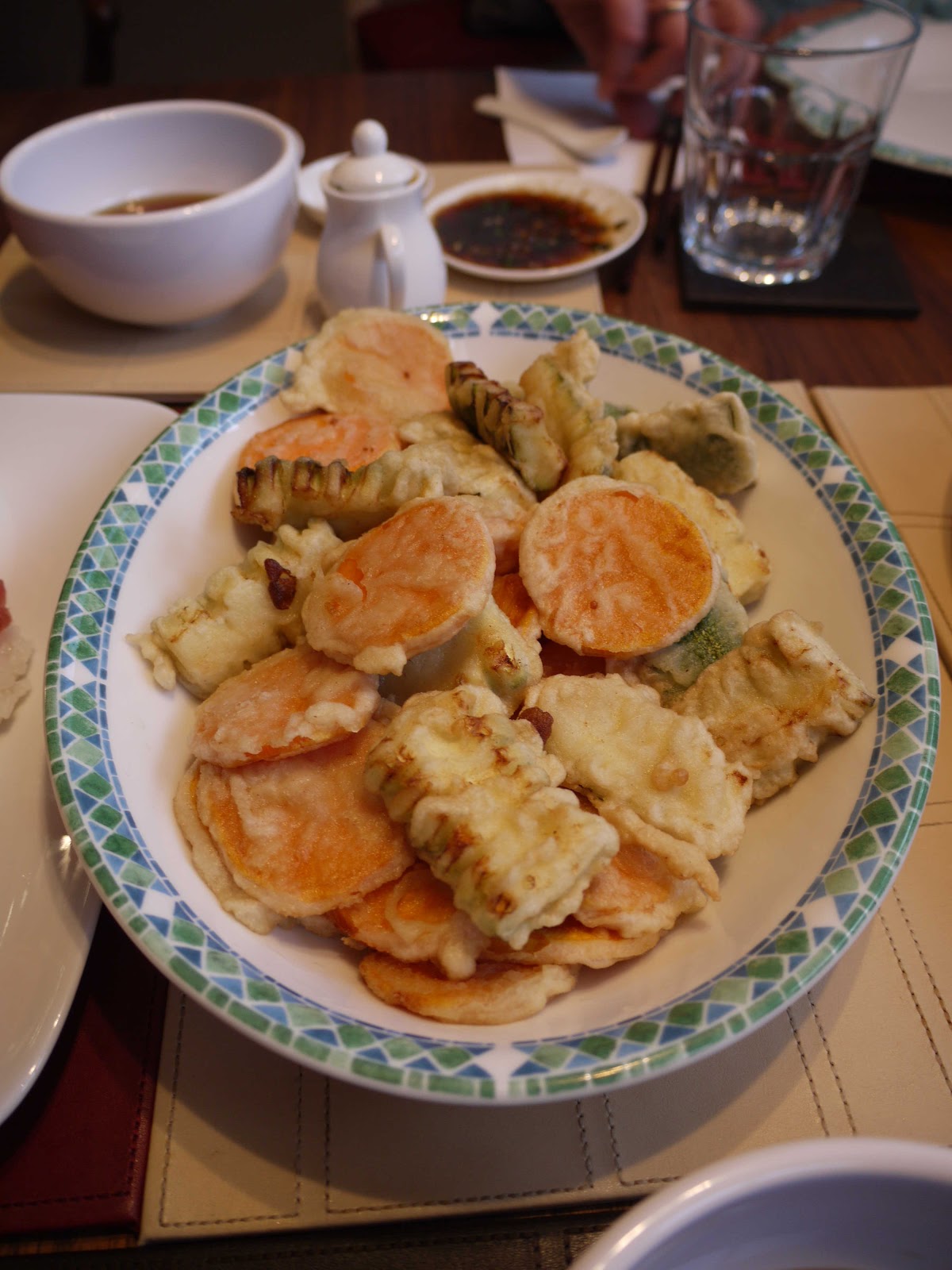
Tonight we used sweet potato for the first time; cut to a half cm thickness, they cooked beautifully and were sweet and tasty. We bought a single medium-sized squid from the fishmonger and sliced the body into rings, and the tentacles and the fins into a few chunky pieces.

We also used courgettes; I decided to try a new way of cutting them as I had had poor results with them in sticks or slices before. I topped and tailed them, sliced them lengthwise, scooped out the seeds, sliced them lengthwise again, and then across into four pieces, making 16 flattish pieces from the single courgette. Then I took a small sharp knife and cut small triangles out along the edges, so that the pieces came out like little combs or fern leaves. This made the batter cling better, cook a little faster, and of course was rather pretty!

Sweet potato and courgette tempura
The batter should be made in a 1:1 ratio of flour to water, which should be ice-cold. If you use sparkling water, you should either defroth it somewhat, or leave the batter to rest for half an hour so some of the bubbliness is gone. If you use it straightaway, sometimes all the carbonation coes out at once, and in the resulting explosion the batter can become separated from the vegetables! Our Japenese cooking book demands 'tempura flour'; when I looked up what this consists of, it is just any plain white wheat flour - preferably a finely milled one for lightness. Nowadays this means any plain white flour from the supermarket will do perfectly fine.

When making the batter, the flour and water should be combined in a few swift strokes, with a butter knife or a pair of chopsticks. Don't use a fork, as it will fill up with flour and you'll end up overmixing the flour as you try to get the goobery bits out. Stop stirring the flour and water together as soon as you can no longer see any dry flour; don't worry if there are small lumps as they'll work themselves out. You can leave the batter to rest, or not; we've not found that it makes any real difference. Just make sure it stays cold.
Squid tempura

After all this preparation, making tempura is simple. A few at a time, drop your vegetables into the bowl of batter, moving around the pieces to make sure they are well coated. Lift a piece out with a pair of tongs, shake off any large excess of batter, then place gently in the hot oil. Cook only a few pieces at a time to avoid dropping the oil temperature too low. Remove to a rack suspended over the wok and then to a bowl lined with paper towel. Ideally, serve immediately, but even when preparing as a side for just four people, you will probably end up with a few soggy ones at the bottom. Maybe there's a good reason to go out to eat tempura every so often, after all :)

Quick Roast Venison and Vegetable Medley


This is a quick and easy way to cook a piece of tender lean venison, like a loin or fillet. This meat can often be tricky to cook as it is very low in fat, so can go dry easily. The method here seals in all of the juices and serves it with a rich medley of vegetebles and bacon to make every bite nice and moist. We served it tonight with steamed beans and carrots, sauteed baby courgettes and fluffy roast potatoes but any seasonal vegetables and parsnip mash or creamed celeriac and potato, or Yorkshire puds would also be delicious.

Ingredients:
  • 800 g venison fillet or loin of venison
  • 150 g fatty lardons
  • a punnet of mushrooms, sliced
  • 1 large leek or two small white onions, finely chopped
  • 1 large clove of garlic
  • 3 tbsp plain flour
  • a wineglass of red wine
  • a wineglass of chicken stock (use low-salt boullion if you have to make from powder)
  • half a bunch of tarragon
  • 3 tbsp redcurrant jelly

Preheat the oven to 220 C; remove the meat from the fridge an hour before you want to cook so that it reaches room temperature. In an oven-safe frying pan, sear the meat on all sides to seal it and then place in the oven for 10 minutes. Remove and cover with foil for 10 minutes, and save any juices to add to the gravy.

To make the accompanying gravy, fry the lardons until crisp and golden, then remove. Fry the mushrooms in the fat, and remove when they have reduced and softened. Soften the onions or leeks in the same pan, adding more oil if necessary. Crush in the garlic and stir in the plain flour and cook for a further two minutes. Deglaze the pan with the red wine. Replace the mushrooms and lardons, stir in the chicken stock, tarragon and redcurrant jelly and bubble for a few minutes until thickened. Season to taste. Slice the venison into bite-size pieces and place on a platter, topping with the vegetable medley. Don't worry if it looks rare as you slice it; it should be served pink and will darken as soon as it is put on a plate.

Thursday, 28 April 2011

Pasta Primavera

A lovely meal to cook in the spring and adapt throughout the season, this relies on a good assortment of fresh vegetables, a few storecupboard tricks and a piquant cherry tomato sauce. Our family adaptation is to add a little seafood - usually some smoked or boiled prawns, or a few flakes of smoked fish, or in this case some succulent sauteed scallops. This serves six hungry people- you can see my dad getting ready to tuck in :)

Ingredients:

  • 1 kg fresh spring vegetables like baby sweetcorn, sprouting broccoli, green beans, asparagus, shelled broad beans, peas etc
  • half a pack of dried porcini mushrooms
  • 200g pine nuts
  • 2-3 punnets of cherry tomatoes
  • 4 cloves of garlic, peeled and crushed
  • 1-2 dried chillies
  • Enough fresh linguine for 6
  • 6-12 large fresh scallops
  • Parmesan cheese

Steam or parboil the vegetables until blanched and crisp. Cover the mushrooms in boiling water and a plate, and soak for 20 minutes. Toast the pine nuts over a low to moderate heat in a non-stick frying pan, until they are golden brown.

Slice half of the cherry tomatoes in half and the rest into quarters. Finely chop the chilli(es) and add with the garlic into a few tbsp of hot olive oil in a deep frying pan, and add the quartered cherry tomatoes thirty seconds later. Allow the tomatoes to collapse gently, over about five minutes, then add the halved cherry tomatoes and cook for a further five minutes. (Two different cuts of tomatoes will give the sauce more texture.)

Set the pasta on to a rolling boil in a slightly salted water. Melt together a tbsp of olive oil and a small slice of butter in another frying pan, and when it is hot and beginning to go gold, add the scallops. Sautee for two minutes on each side, until golden brown. Drain the linguine and toss with the vegetables and plenty of grated Parmesan, seasoning with a good grinding of black pepper. Serve in a large dish topped with scallops, alongside small bowls of spicy tomato sauce for people to add, and more Parmesan if desired.

Monday, 25 April 2011

Chinese Steamed Sea Bass and Egg-Fried Rice

After a long but quite fun drive up to Edinburgh, we had a cup of tea, a stroll and then made this light and delicious meal for four - my sisters had yet to arrive. Originally there was an official recipe in an official book, but  that has disappeared into the mists of time, and now this is an improvisational recipe doable with whatever springs to hand. I've done this with red mullet, flavoured with spring onions, shavings of root ginger and coriander stems. Tonight we go for something a little deeper-flavoured, as the weather up here is about 15 C cooler than the Southern heatwave!

Ingredients:
For the fish:
  • 4 fresh sea bass or bream
  • a few tbsp of fermented black beans
  • 3 balls of stem ginger in syrup
For the rice:
  • 300g white (basmati) rice
  • 3 spring onions
  • 2 eggs, lightly beaten
  • a cup of frozen peas
  • soy sauce
For the vegetables:
  • any good stir-friable vegetables, like baby sweetcorn, sugarsnap peas, red or yellow peppers, chinese leaf, water chestnuts, bean sprouts, mushrooms, etc
  • 150 ml chicken stock
  • 50 ml cold water
  • 2 tbsp cornflour

Gut, scale and clean the fish, and slash two or three times across the fattest part of the meat. Finely dice the ginger and stuff the fish with it and the black beans. Wrap in foil and bake at 180C for 30 minutes, or put in a steamer and steam for 20 minutes.

If you like, clean the rice with a few rinses of cold water -- I don't, but my dad does! Simmer in twice as much water until cooked through, and drain if necessary. Leave aside to cool a little. Heat a deep frying pan with peanut or refined sesame oil, and once shimmering, add the rice and toss about to fry. Roughly chop the spring onions, move the rice aside and add them to the pan, with a little more oil if necessary. Once they are cooked, move them aside and pour in the eggs, again with a little more oil if needed. Allow to cook through on the bottom, then flip over and fry the other side. When it is nearly cooked through, break it up with a spatula. Add the cup of peas and combine all the ingredients together. Splash over a little soy sauce and serve immediately.

For the vegetables, stir fry them in order of decreasing cooking time, cooking things like carrots and peppers at the beginning, and soft things like beanspouts and greens just at the end. Each time, add your vegetable selection, toss about at a high heat, then add a few tbsp of chicken stock and cover to steam-cook. Mix the cornflour into the cold water, and when you run out of stock and vegetables, add this, bring up to a simmer and allow to reduce to a light sauce. Taste and season with fish and soy sauce if needed.


Monday, 28 February 2011

Roasted Roots with Puy Lentils

I've had a lovely relaxing weekend, and actually haven't been cooking the main meals. I did pick up my wedding dress in London - then gave it to my sister for safe-keeping until the wedding. After a long walk in the surprising February sunshine, lunch today was reheated laksah, still delicious after the flavours had mellowed together a touch. I'd like to write about another dinner that works well as lunch to reheat: roasted roots with puy lentils.

You can use any mixture of roots here, but I find potatoes always take longer than other roots and tend to be overwhelmed by their stronger flavours, so are better not included. The lentils are also up for substitution: puy lentils are the most delicious and hold their shape after cooking, but the cheaper brown or green varieties also work well here. You can also adapt the herbs and dressing depending on what you have to hand. I like to leave the garlic unpeeled so it roasts without burning; it turns into a delightful squidy savoury burst of flavour, hiding underneath the papery skin. I love the sharp contrast between the smoky garlic and the sweet ruby beetroot.

Ingredients:

  • 1 sweet potato
  • 2 parsnips
  • 3 carrots
  • 4 medium beetroot, including stems and leaves
  • 1 large leek
  • 1/2 large head of garlic
  • Small bunch of thyme
  • 1 tsp coriander seed
  • 1/2 tsp cumin seed
  • olive oil
  • 200g lentils
  • 4 tbsp balsamic vinegar

Preheat the oven to 180 C. Remove the stems and leaves of the beetroot and set aside, discarding the bitter join between the stems and the roots. Scrub or peel the roots, remove any sprouts or odd bits, and chop into largeish bite-sized pieces, about 2-3cm in size. Remove the cloves from the large head of garlic, but do not peel. Put the vegetables and garlic in a roasting tin, or two if needed, making sure the vegetables are in a single layer and not stacked, or those underneath will steam instead of roast. Lightly crush the coriander and cumin in a mortar and pestle, strip the leaves from the thyme, and add to the vegetables. Toss with enough olive oil to give the vegetables a fine coating, about 2tbsp. Roast in the oven for 35-45 minutes or until crisping at the edges and tender on the outside, turning the vegetables about halfway through. Be careful not to break up softer roots like sweet potato.

Meanwhile, cook the lentils according to their packet instructions: I use 4:1 water:lentils, simmering, without salt (adding salt causes the lentil shells to harden before the insides cook through). Halve the leeks lengthwise and wash throughly, then chop into 2cm-wide strips. Remove the leaves from the beetroot stems. Chop the stems into 1cm lengths and sautee with the leeks in a little olive oil or butter over a low heat, until the leeks are soft and just edging golden. Then stir in the beetroot leaves, and switch off the heat; they will cook, like spinach, in mere residual heat.

When the root vegetables and lentils are done, drain the latter, and throw the leek mixture, roots and lentils together in one of the roasting tins. Toss with balsamic vinegar and a splash more olive oil if you like. Season with black pepper and serve! If you're extra-hungry, you can add some chunks of goats cheese, some snippets of grilled streaky bacon, or a few broken-up cooked chestnuts (pictured here). Toasted sunflower or pumpkin seeds would also work deliciously well.