Showing posts with label Japanese. Show all posts

Sunday, 9 November 2014

Yasai Cha Han

This weekend was chore-tastic but also really hot, so I wanted something nourishing but not too heavy. I'm still working my way through the vegetarian section of the Wagamama cookbook, and this recipe called for things I mostly already had in the fridge. A quick cycle to the local grocer (and a quick swim when we got back to cool down) and I was able to pick up the rest of the ingredients. It was super-fast to prepare; easily a new weekday meal for me. You'll want really good fresh ingredients for this, as there are no other flavourings beyond soy sauce, so the vegetables need to speak for themselves. The rice instructions and the sheer amount of salt were both a shock to me, but I followed the recipe and they did work out.

Ingredients
  • A ladleful of Thai fragrant rice
  • Four ladlefuls of boiling water
  • two king oyster mushrooms, cubed
  • 250g firm tofu, cubed
  • 8-10 baby sweetcorn
  • 15-20 sugarsnap peas
  • 4 spring onions, trimmed and cut into 4cm pieces
  • 1 tsp salt
  • 3 tbsp light soy sauce
  • 2 eggs
Cook the rice in the boiling water on a medium heat for 4-5 minutes, until softened but not done. Drain and refresh under cold running water; set aside. If you have wobbly tofu (which I usually do), fry the tofu in a little oil in a hot wok, turning carefully and occasionally until lightly seared on a few sides. Scoop out and set aside.

Turn the heat up, add a little more oil, and stir-fry the mushrooms for five minutes, until golden and bouncy. Throw in the vegetables, rice, salt, and soy sauce, and stir fry for a further 2-3 minutes, until the rice is cooked and the vegetables are bright. Add the egss and stir fry until they are just cooked. Divide between two bowls and serve with miso soup on the side.

Monday, 3 November 2014

Asparagus Shiraae

Asparagus is in season, and I have a Japanese food craving. Irreconcilable? I do not think this word means what you think it means! I went out on a limb and tried the most unusual (to me) recipe from The Guardian's Top Ten Asparagus Recipes. This definitely isn't for everyone... I can imagine the texture would really be off-putting for people who don't like jelly. But if you know you like soft tofu and sesame, give this a try. The recipe said serves four... well, that was total nonsense. Served two of us, with plain boiled rice and nasu dengaku to go with.

Ingredients

  • 300g soft/silken tofu
  • 200g asparagus
  • 4 tbsp sesame seeds, toasted and ground
  • 2 tbsp caster sugar
  • 1 tsp light soy sauce
  • ½ tsp miso
  • Salt

Drain the tofu from the packet, wrap it in plenty of kitchen paper, put it on a plate and place a weight on top of it to squeeze the water out. Leave the tofu for 30 minutes, until it weighs around 180g. Remove the woody part of the asparagus, then cut each spear diagonally into thirds.Bring some water to the boil in a saucepan, then add a little salt and lightly cook the asparagus for a few minutes. It should still be firm when drained. Cool the spears under cold running water and pat them dry.

Put the tofu in a bowl and add the ground sesame seeds, sugar, light soy sauce and miso and mix thoroughly. Add the asparagus to the bowl and mix into the dressing, seasoning with extra salt if required. Serve!

Tuesday, 19 August 2014

Yasai Itameru (Stir-fried tofu in coconut noodles)

I went back to the Wagamama cookbook for this one, and it wasn't half bad. I think the recipes still lack focus, having too many different kinds of vegetables, and the quantities are all over the place. However the sauce was very tasty, if a little rich. I also think it's silly to try to stir fry tofu at the same time as your vegetables: you can get a nice crispy skin if you do them separately, as shown in the photo. I'm posting my amended recipe rather than their original.

Ingredients
For the sauce

  • 1 garlic clove
  • a thumb of ginger
  • two lemongrass sticks
  • 100ml hot water
  • 1 tsp salt
  • 3 tsp sugar
  • 100g in of coconut milk or cream (depending on how fat you feel)
For the stir-fry

  • 75g rice noodles
  • 1 red chilli
  • 1 red onion
  • a bunch of Chinese vegetables, like pak choi
  • 50g sweet potato (about an inch from the middle)
  • 200g firm tofu, cut into cubes
  • a bunch of fresh coriander
  • juice of half a lime (or lemon)
  • 2 tbsp light soy sauce
Crush the garlic, peel and grate the ginger, and finely shred the lemongrass. Cook in a small saucepan in the hot water until the garlic has softened. Stir in the remaining ingredients and cook gently for a few minutes, but don't let it boil or the coconut milk can separate.

Cook the noodles according to their packet instructions. Peel and (if you like) deseed the chilli, then finely chop. Finely slice the red onion. Julienne the sweet potato. Clean and separate the pak choi. Stir fry the sweet potato and red onion until becoming tender, then add the rest of the vegetables and stir fry until just barely cooked, then remove from the pan to free it up for the tofu. Stir fry the tofu until golden and crispy, then return the vegetables to the pan and squeeze over the lime juice and soy sauce. Combine the noodles with the coconut sauce, and serve the vegetables over the top of them, topped with the coriander and a lemon or lime segment.

Wednesday, 23 January 2013

Okonomiyaki (Japanese Savoury Pancake)

Another inspiration from my amazing Flavour Thesaurus, with guidance from one of my favourite food blogs and a helpful Japanese cooking info page. This time I was reading the underwhelming-sounding 'cabbage and egg' section. Turns out the Japanese have a long tradition of making these gorgeous savoury pancakes with a range of different ingredients, but almost-always including shredded cabbage as the base. And since cabbage was on my list of 'cheap veg at the market this week', I have a whole head to use up. I made up the money saved buying the cabbage by buying beautiful katsuobushi, the dried bonito flakes that 'dance' in the convection currents generated by the hot pancake. I also made my own okonomiyaki sauce, which meant I had to buy ketchup for the first time in my life. Oh well - maybe when winter rolls around I'll deep-fry some potato chips. Or, more likely, I'll just make these again, because they were AMAZING! Even easier to flip than Korean pancakes, less fiddly than fried veggie fritters, and absolutely divine in flavour. I think it's worth putting in the extra effort to make the sauce, and track down the katsuobushi and wakame (dried seaweed).

Ingredients
What is so exciting about this seaweed??
For the pancake: 
  • 1/4 white/green cabbage
  • 1 carrot
  • 2 spring onions
  • 1 egg
  • 3/4 cup room-temperature dashi stock (substitute seafood stock, or vegetable stock, or even water)
  • 1 cup plain flour

For the toppings:

  • 2tbsp ketchup (tomato sauce)
  • 2tbsp Worcestershire sauce
  • 1 tsp dark soy sauce
  • 1 tsp sugar
  • 2 tbsp mayonnaise
  • 50g katsuobushi (fine bonito flakes)
  • a small handful of wakame (dried seaweed)
Japanese pancake on the barbie.
Now that's what I call fusion food :)
Shred the cabbage, grate the carrot and finely slice the spring onions. Combine with the egg, stock and flour in a large mixing bowl. Get a bbq hot plate nice and hot and brush generously with oil. When you can see it start to shimmer, plop the mixture onto the hotplate and push down and smooth out to make a pancake or two (how many depends on your confidence in your ability to flip them!). Close the lid and bbq for 5-10 minutes, until crisp and golden on the bottom, and cooked through enough not to fall apart when you lift the edges with a spatula. Flip onto the other side and cook for a further 5-10 minutes.

Meanwhile, combine the ketchup, Worcestershire sauce, soy sauce and sugar in a small bowl, to make the okonomiyaki sauce. Put the mayonnaise in a small plastic bag with the corner cut off, or piping bag, if it's not in a squeezy bottle already. When the pancake is nearly done, turn off the heat and brush the top surface with the okonomiyaki sauce. Pipe on the mayonnaise in long lines, or whatever pattern you like. Tip on the katsuobushi and scatter with a handful of wakame. Serve hot off the grill, with the bonito flakes dancing to their tasty song :)

Monday, 11 June 2012

Miso Soup with Shimeji Mushrooms

A slightly bulked-up variant on my previous miso soup, as I had a very long day running around getting my Indian visa sorted, suffered a flat tire on my bicycle, and had to catch up on nearly a week's worth of email. Helpful husband locked himself out of the house so I needed to put together something fairly quickly. I attempted to follow a recipe, but substituted every single ingredient. Heh.

Ingredients:

  • a small handful of dried shitake mushrooms
  • 3 tbsp sesame seeds
  • sesame oil
  • a sweet potato, daikon, carrot, or parsnip
  • 1 tsp dashi or seafood stock powder
  • 3 tbsp of miso paste
  • a couple of pak choi or bok choi, or other leafy Chinese vegetables
  • a block of shimeji or a couple of handfuls of oyster mushrooms
  • two spring onions
  • finely shredded nori (seaweed)

Pour enough boiling water over the shitake mushrooms to cover, and leave for at least ten minutes to fully rehydrate. Dry-fry the sesame seeds until golden, then set aside for later. Peel and cut the sweet potato (or other root vegetable) in half lengthwise, then into fat half-moons (about the only thing I kept from the original recipe). Prepare a wok with a tsp of sesame oil and a tsp of vegetable oil, and a large stock pot or sauce pan with the stock powder in the bottom. Fry the sweet potato in the wok for a few minutes, turning irregularly, so it begins to caramelise. When the half-moons have taken on a golden colour around the edges, tip them into the stock pot, and cover with boiling water. Add the miso paste, shitake mushrooms, and their soaking water (although be careful not to add any grit). Simmer for five minutes - stop as soon as the sweet potatoes begin to yield to a fork.

Meanwhile, separate the leaves from the pak choi, and cut the stalks into diagonal pieces. Stir fry for a couple of minutes, then add to the soup in the stock pot. Separate the shimeji mushrooms with your hands. Turn the wok up to a high heat, then fry the mushrooms for a minute on each side, then add them to the soup. Slice the spring onions lengthwise and roughly chop with the pak choi greens, then add them to the soup. Simmer for a minute or so to bring the soup up to temperature, finish cooking the sweet potato, and wilt the greens, then turn off the heat. Taste and add more miso or a splash of soy sauce if necessary. Serve with the sesame seeds and shredded seaweed scattered over.

Wednesday, 2 May 2012

Nasu Dengaku and Wasabi Broccoli

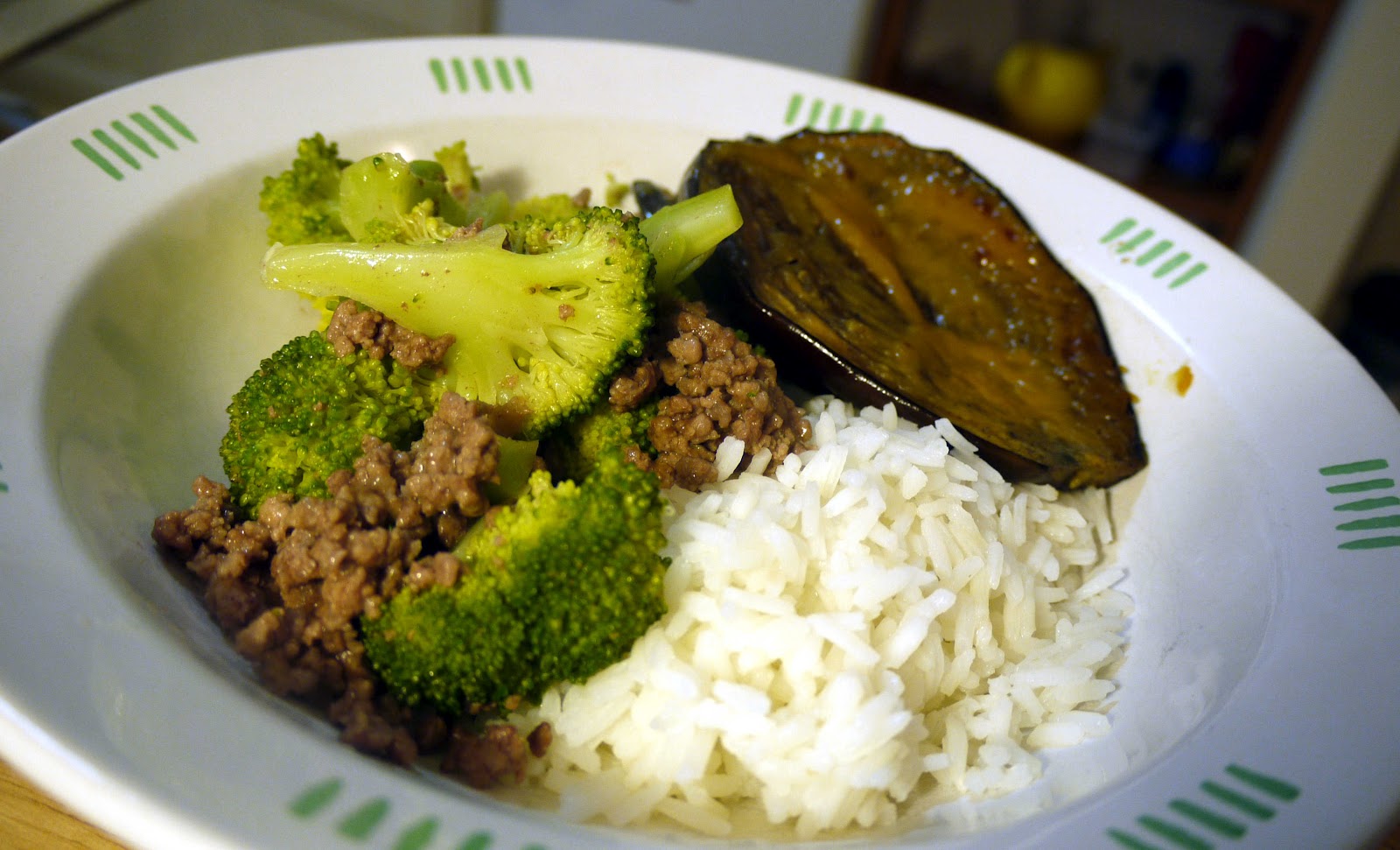
Nasu dengaku is a Japanese glazed eggplant (aubergine) dish that I discovered a few years ago in a lovely little restaurant in London. Since then I find it hard NOT to order, since it's so wonderful and every restaurant does it slightly differently. My favourite style is where they give you one HUGE slice of aubergine, with fat stripes of slightly different glaze across it, like chilli, sweet, and wasabi. Today I thought I'd start with the basic recipe, adapted from this helpful website. Their photos are a lot better than mine - I forgot to put the sesame seeds on at the end! I won't even repost the recipe because it was exactly right for one aubergine, and I didn't change it at all.


Recently we went to a great local Chinese restaurant and they had an 'Innovation Menu', which included 'wasabi beef'. This turned out to be thinly sliced pieces of beef, quickly fried and coated in a thick but somehow not overpowering wasabi sauce. I tried to replicate it today, using mince instead to save money while I worked out the recipe. Couldn't get the sauce quite right so I will keep iterating and see what I can come up with.

Wednesday, 26 October 2011

Katsudon

This is one of my favourite Japanese dishes; I often order it in restaurants because it's the sort of thing I figure would be fiddly to make at home. But after buying the deep-fat-fryer, I wanted to give it a try! I followed this helpful youtube video, and made a couple of slight changes for my kitchen and tastes. Also I served it with some stir-fried pak choi with garlic and sesame oil, so that I would have some greens with it. Still very much a treat of a recipe, I'd balloon if I ate it every night :)

Ingredients

  • 300g pork fillet or loin, cut into two big pieces, or two deboned pork chops 
  • plain flour
  • 2 eggs
  • 1 fat slice of bread, whizzed into breadcrumbs
  • white rice
  • half a white onion
  • 300ml hot water
  • 3 tbsp soy sauce
  • 1/2 tsp fish sauce
  • 1/2 vegetable stock cube
  • 2 tbsp mirin or cooking wine
  • 1 tsp raw or demerara sugar

Set your white rice cooking according to its packet instructions. Lay the pork out on a breadboard and cover with a plastic bag. Beat with a rolling pin until 1cm thick or less all over. Put a few tbsp of flour on a plate, put the breadcrumbs on another one, and break an egg onto a final one, whisking gently with a fork to break up. Dip the pork in the flour, then the egg, then finally the breadcrumbs, shaking off any excess at each stage. Deep-fry at 180 C for 8-10 minutes, until the breadcrumbs are golden and the pork is just pink in the middle.


Meanwhile, peel and finely slice the onion into half-moons. Break the remaining egg into a small bowl. Put the rest of the ingredients in saucepan and bring to a simmer, then add the onion. Cook for ten minutes, until the onion is soft and the pork has finished deep-frying. Take the pork out of the deep-fryer and lay it out on a (clean!) breadboard. Slice it thickly, diagonally, then use a spatula to transfer the whole thing to the saucepan with the stock and onions. Drizzle over the egg and immediately cover. Simmer for one minute, then use a big spatula or slotted spoon to serve the whole thing atop a mound of freshly cooked white rice. Pour over the onion and egg sauce. YUM!


Saturday, 30 April 2011

Tempura


Tempura are the lighly and fluffy deep-fried batter-coated vegetables and seafood often served as a starter in Japanese restaurants. As my dad sadly observed, now that we can make them so well at home, we no longer need to go out to eat them! There are a few tricks to cooking them, which we have perfected over the years:

  • The batter should be barely combined, not whisked until smooth, so that the gluten does not become tough;
  • The batter should be kept cold, preferably suspended in a bowl of ice and water;
  • Slice the vegetables so that they evenly cook, i.e. have similar thickness all over;
  • Some vegetables benefit from being 'flowered' so that the batter clings better;
  • The oil should be at least the depth of the size of your vegetables;
  • The oil should be about 190 C; if you don't have an oil thermometer, a cube of bread should take 10 seconds to go crisp and golden;
  • A rack over the wok helps to drain the oil back into the pan for re-use.


Making cuts in the courgette pieces
so the batter clings better
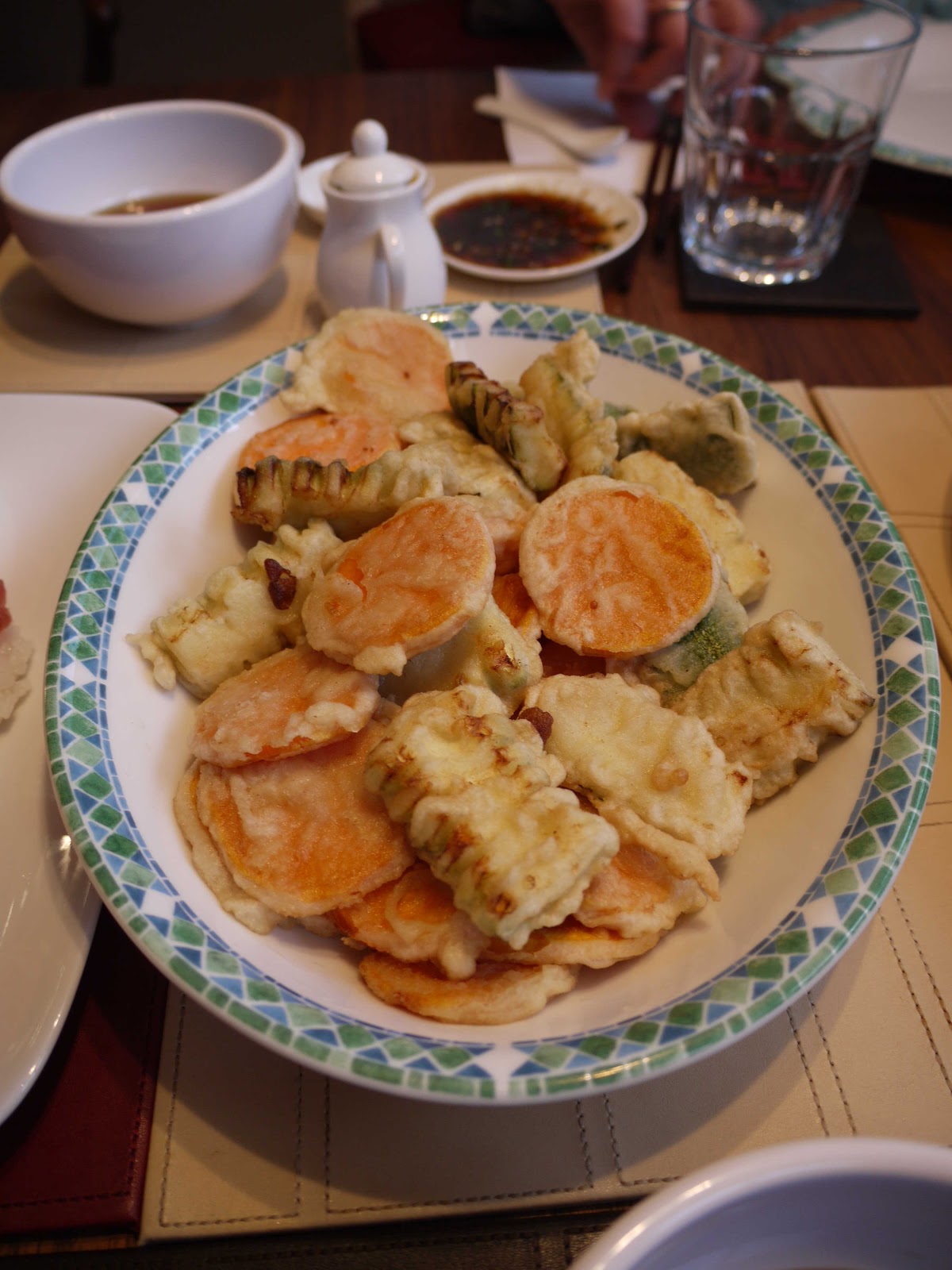
Tonight we used sweet potato for the first time; cut to a half cm thickness, they cooked beautifully and were sweet and tasty. We bought a single medium-sized squid from the fishmonger and sliced the body into rings, and the tentacles and the fins into a few chunky pieces.

We also used courgettes; I decided to try a new way of cutting them as I had had poor results with them in sticks or slices before. I topped and tailed them, sliced them lengthwise, scooped out the seeds, sliced them lengthwise again, and then across into four pieces, making 16 flattish pieces from the single courgette. Then I took a small sharp knife and cut small triangles out along the edges, so that the pieces came out like little combs or fern leaves. This made the batter cling better, cook a little faster, and of course was rather pretty!

Sweet potato and courgette tempura
The batter should be made in a 1:1 ratio of flour to water, which should be ice-cold. If you use sparkling water, you should either defroth it somewhat, or leave the batter to rest for half an hour so some of the bubbliness is gone. If you use it straightaway, sometimes all the carbonation coes out at once, and in the resulting explosion the batter can become separated from the vegetables! Our Japenese cooking book demands 'tempura flour'; when I looked up what this consists of, it is just any plain white wheat flour - preferably a finely milled one for lightness. Nowadays this means any plain white flour from the supermarket will do perfectly fine.

When making the batter, the flour and water should be combined in a few swift strokes, with a butter knife or a pair of chopsticks. Don't use a fork, as it will fill up with flour and you'll end up overmixing the flour as you try to get the goobery bits out. Stop stirring the flour and water together as soon as you can no longer see any dry flour; don't worry if there are small lumps as they'll work themselves out. You can leave the batter to rest, or not; we've not found that it makes any real difference. Just make sure it stays cold.
Squid tempura

After all this preparation, making tempura is simple. A few at a time, drop your vegetables into the bowl of batter, moving around the pieces to make sure they are well coated. Lift a piece out with a pair of tongs, shake off any large excess of batter, then place gently in the hot oil. Cook only a few pieces at a time to avoid dropping the oil temperature too low. Remove to a rack suspended over the wok and then to a bowl lined with paper towel. Ideally, serve immediately, but even when preparing as a side for just four people, you will probably end up with a few soggy ones at the bottom. Maybe there's a good reason to go out to eat tempura every so often, after all :)