Showing posts with label tomato. Show all posts

Sunday, 10 December 2017

Probably Not-That-Authentic Seafood Paella

Sooo.... kids really take a toll on my ability to blog. I can't believe it's been nearly 18 months since my last post. I have given birth to another human being since then. And in the intervening time, 95% of my cooking has been repeating things I already knew. There's just not much time to do anything else!

However, on some weekends we've had a chance to get a little fancier, and this weekend I had a real craving for paella, spurred on by a cool Spanish rice variety I bought a few weeks ago. So I cribbed from this receipe but changed it to be much less seafood-heavy. It's now actually doable in under an hour, without all that seafood prep! Still tastes excellent, too. This serves four people with salad or vegetables on the side.

Ingredients

  • 1/2 cup (125ml) dry white wine
  • 1/2 teaspoon saffron threads
  • olive oil
  • 2 brown onions, finely chopped
  • 2 red capsicums (raw and chopped or roasted, peeled and torn)
  • 4 garlic cloves, crushed
  • 1/2 - 1 chorizo sausage
  • 2 large ripe tomatoes, halved, seeded, finely chopped
  • 2 teaspoons mild Spanish paprika
  • 1 1/2 cups (300g) medium grain rice (such as calrose)
  • 2 cups (500ml) chicken stock
  • 500 - 750g marinara mix
  • 1/2 - 1 cup (150g) frozen peas
  • chopped parsley
  • Lemon wedges, to serve


Method
I need to dig out my decent camera! My phone
doesn't really do it justice. Anyway, note the crispy
crunchy tasty base. It was amazing.
Heat the wine and saffron over a low heat until just coming to a simmer, then stir and turn off the heat, reserving for later. In a paella pan or a large, deep frying pan, fry the brown onions and raw capsicum (if using), for five minutes, until the onion is soft and beginning to go gold. Add the garlic and chorizo and fry for a further thirty seconds. Add the onion, paprika, and rice, and stir together. Add the reserved saffron wine, and chicken stock, and cook uncovered for 15 minutes over a medium heat.

Stir in the marinara mix and frozen peas, cover, and cook for a further five minutes, turning the mix a little to get it all cooked through. Resist the urge to unstick the rice at the bottom of the pan, so that you get those authentic paella crunchy bits. Scatter over chopped parsley and serve with lemon wedges.

-----------------------------------

I'm hoping in 2018 I can post here a little more. I have a funny plan for the first couple of months which I'm looking forward to sharing, along with more "fancy
 recipes from the weekend. We'll see... best-laid plans of mice and men...!

Saturday, 30 January 2016

Spiralized Pasta with Butternut Squash

A spiralizer take on our family favourite! Learning from my previous spiralizer experiences, I cooked the sauce until it was completely dry, in a frying pan that seemed way too big for it. I spiralized three courgettes on the tagliatelle setting, and added them once the sauce was dry. After a few minutes, they suddenly collapsed and let out all of their water, which rehydrated the sauce enough to coat the "pasta". I served it immediately, topped with grated parmesan, and the whole meal was fantastic!

Monday, 18 January 2016

Spiralizer Week: Day One: Puttanesca Sauce

My middle sister gave me a Spiralizer for Christmas, so I decided that this week would be Spiralizer Week, and every day I would do a different recipe from a beginner's Spiralizer recipe blog: a nice way to ease back from all-salads into slightly more filling food, while hopefully still shedding a few Christmas pounds. We started off well with this "spaghetti" alla puttanesca. You could, of course, make it with normal pasta, and it might fill you up for a little longer.

Ingredients
  • 1 clove of garlic
  • 2-3 anchovy fillets
  • 400g can of chopped tomatoes
  • 1 tbsp capers, chopped if they are large
  • salt and pepper, to taste
  • 2-3 tbsp chopped parsley
  • 1/4 cup sliced olives
  • 1 tsp chilli flakes (optional)
  • 2 zucchini, spiralized into thin noodles
Method

Crush the garlic into a frying pan with a little oil (use olive, or if you prefer, anchovy oil from the jar) and snip in the anchovy fillets, then fry over a low heat until the anchovy has dissolved and the garlic has softened. Pour in the tin of tomatoes and add the parsley, capers and olives; season with chilli flakes, if using, or black pepper. Simmer for about 10-15 minutes or until liquid from the sauce has completely evaporated.

Once the sauce is dry, add the zucchini noodles, and cook until they have *just* softened and enough water has come out to make the sauce a little liquid. Stop cooking immediately and serve the noodles with the sauce.

Saturday, 16 January 2016

Gazpacho

I was first served gazpacho by my family in Provence, a couple of years ago when I visited after a conference. Naturally it was achingly hot outside, which is the perfect time, perhaps the only time, for cold soup. But this gazpacho is far tastier than that sounds! I could not believe how refreshing and zingy it was, and now I've finally replicated it down under, I'm looking forward to whizzing it up whenever I need a light and refreshing lunch.

Ingredients
  • 500g fresh tomatoes
  • half a cucumber
  • a red pepper
  • a slice of bread, preferably stale
  • a clove of garlic
  • 1tsp Worcestershire sauce
  • 50ml wine vinegar
  • 50ml olive oil
  • a fresh chilli (optional)
  • basil leaves, Tabasco, pepper, olive oil to serve
Cut off the stem bits of the tomato, pepper, chilli if using, and skin and crush the garlic. Chuck everything in a liquidiser and pulse until well blended. Serve in little glasses with little spoons, topped with basil leaves, and with extra olive oil, black pepper and Tabasco on hand to add to taste.

Thursday, 23 July 2015

Kangaroo Bolognese

Continuing my theme of using kangaroo mince in everything, I tried out a kangaroo bolognese. Like the mousakka, it was actually an improvement on the original, because of the leaner, tastier quality of the meat. Without all the fat from typical beef mince, the sauce no longer has that thick layer of red oil which coats and stains everything. Instead it's pure bolognese heaven -- fantastic on pasta or as a component of classic lasagne. I seem to be the only one in the universe who insists on mushrooms in bolognese, but whatever. It's not a real Italian sauce anyway, so I can put whatever I like in it!

Ingredients

  • 1kg kangaroo mince
  • 2 brown onions
  • 2 carrots
  • 1-2 sticks celery
  • 500g button or smallish mushrooms
  • 4 cloves of garlic
  • 6 rashers bacon (back or streaky, either is fine)
  • 680g tomato passata or 2x325g tinned tomatoes
  • 150g tomato puree
  • 2 tsp dried oregano
  • 1 tsp dried rosemary
  • 2 bay leaves
  • 1 tsp dried red chilli flakes (optional, but I strongly recommend them)
  • glass of red or white wine
  • 1 cup milk or half a cup of cream (optional)
Finely dice the onions and fry with the kangaroo mince, breaking it up and stirring until the mince is brown and the onions are soft. Meanwhile, dice the carrots, finely dice the celery, and cut the small mushrooms in half, or slice them if they are larger. Crush the garlic and snip or cut the bacon into 2cm-long strips. Add the carrots, celery, mushrooms, garlic and bacon to the onion and mince, stir well, and cook until the mushrooms have softened.

Add the tomato ingredients, herbs, wine, and chilli flakes if using. Rinse out the tomato jar or cans with a cup of water and pour into the sauce. Stir until combined, then partly cover and simmer for 2-4 hours, until thickened and delicious. If the sauce starts to dry out, add a little water and completely cover, but don't reduce the cooking time.

Five minutes before serving, add the milk or cream. If you want to keep the bolognese in the fridge and reheat it later, or use it in a lasagne, I suggest not adding the milk or cream until you do come to serve it or use it, as it will keep better.

Tuesday, 2 June 2015

Kangaroo Moussaka

The grocer had a special on aubergines (not very seasonal but at a dollar each, grown in Australia, how can one resist?) and I really wanted to make moussaka. Unfortunately, the only thing less seasonal than aubergines at the moment is lamb! Neither the butcher nor the supermarket had any lamb mince, nor were willing to make any. So I thought -- why not try a kangaroo moussaka? The meat has a similar gaminess, and it's a more environmentally-friendly option in this country.  It's also a healthier option as it's generally leaner than lamb.If you're making this outside Australia, of course feel free to use lamb mince, or a mixture of beef and pork if you prefer.

One thing that's a little off-putting about the kangaroo mince is that it doesn't smell nearly as good early on in the cooking, but after 45 minutes of simmering, it suddenly disintegrates and becomes just as if not more tasty than lamb. So stick with it, it'll work out in the end!

I started with this recipe and modified it to suit my own tastes. I really prefer having potatoes separate to the moussaka, for contrast -- baked or mashed, either way. If you need to feed more than six people, but don't want to / can't buy fractionally more kangaroo mince (it comes in 1kg packs in my supermarket), feel free to bulk out the moussaka with a couple of grated carrots, or a cup of cooked lentils.

Ingredients

  • 1 large or two small brown onion, finely chopped
  • 6 garlic cloves, peeled and finely chopped or crushed
  • 1kg kangaroo mince
  • 2 carrots, cleaned and grated or a cup of cooked lentils (optional -- use if you need to feed more people)
  • 1 stick celery, finely diced
  • 1 tsp ground cinammon
  • 2 bay leaves
  • 1/2 cup dry white wine
  • a tin of chopped tomatoes
  • 3 large eggplants (aubergines)
  • olive oil
  • 1 small handful flat leaf parsley, chopped
  • 2 tsp dried oregano
  • 120g butter
  • 1 cup plain flour
  • 4 cups warm milk
  • 1 bay leaf
  • ground or freshly grated nutmeg
Method


Heat a little olive oil in a non stick pan and gently saute the onion until starting to soften. Add the garlic and cook until fragrant. Add the mince, breaking it up with a wooden spoon. Cook the mince until it loses all its water and begins to brown. Add the diced celery. If using, add the carrot or lentils. Add the cinammon, bay leaf, herbs and wine; stir and deglaze the pan, then add the tin of tomato and simmer for 45 minutes.

Meanwhile, grill or barbeque the eggplants, brushed with olive oil, until soft and golden on both sides. Also, make a bechamel sauce: melt the butter in a pyrex bowl, in the microwave, then stir in the flour. Gradually whisk in the milk, drop in the bay leaf and nutmeg, then microwave for five minutes, stirring every minute. The sauce should thicken.

Set the oven temperature to 180C. In a large rectangular dish, alternate layers of eggplant and mince until the dish is nearly full. Check the bechamel and taste for seasoning. Spoon over the top and smooth it over with a spatula. The layer should be quite thick. Bake for 25-45 minutes or until it’s all golden and bubbly. Serve with mashed or baked potato, and steamed vegetables or Greek salad.


Tuesday, 9 September 2014

Lamb Kofta with Tomato Sauce

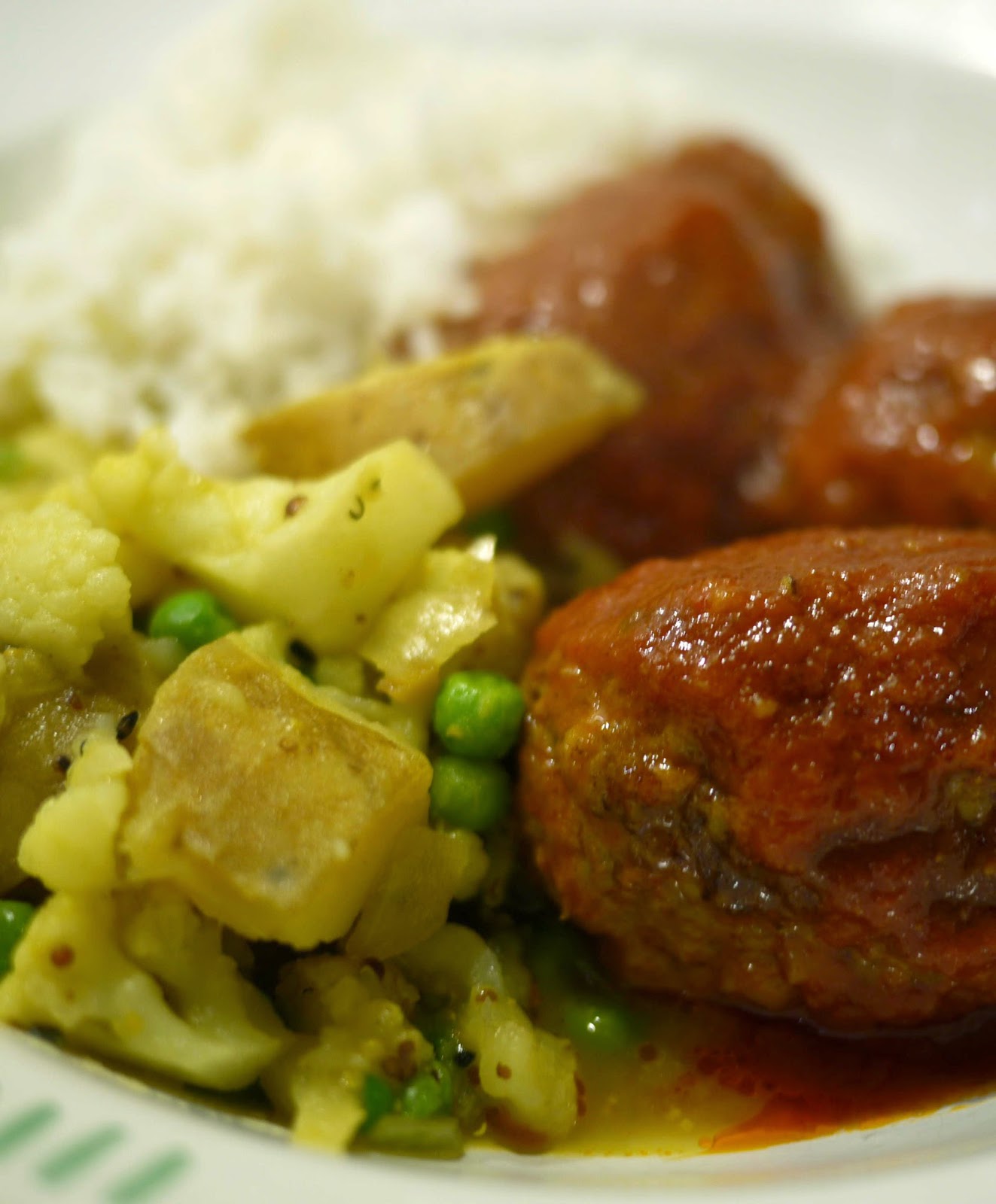
The well-meaning but somewhat dappy SO managed to buy 1kg of lamb mince when I'd asked for diced lamb -- I suppose it was just extremely well-diced. So I had to think of a way of using a huge amount of lamb mince, and I didn't really feel like mousakka or shepherd's pie. So for the first time, I made kofta! I had a few jars of homemade passata that a friend had given me so used one as a base for the tomato sauce, but you could easily use a tin of chopped tomatoes and cook it for longer. Loosely following this recipe, we didn't fry the onions first, and the final result had a distinctly raw-onion-y flavour. So I recommend frying them first, if only for a minute or two, just to get rid of that rawness.  I served this with aloo gobi and plain basmati rice.

Ingredients

  • 1 onion (white or red)
  • a large bunch of parsley
  • a slice of day-old bread
  • 6 garlic cloves, crushed
  • 2 tsp ground cumin
  • 2 tsp ground coriander
  • 1 tsp ground cinnamon
  • 1 tsp chilli flakes (optional)
  • 500g lamb mince
  • 75g plain flour
  • 1 egg, lightly whisked
  • a tin of chopped tomatoes or a jar of passata
  • 3 tbsp curry powder
Finely chop or zap the onion in a blender and fry for a few minutes, until the rawness has gone and the onions turn sweet. Meanwhile, blitz the parsley, bread, garlic and spices in a blender and dump into a mixing bowl. Fold in the cooked onions and lamb mince and blend well. Stir in the plain flour and then the egg. Bring the mixture together and form into large-egg-sized meatballs.

Fry in olive oil for a few minutes on each side, until browned. Meanwhile, cook the tomatoes with the curry powder in a large saucepan, seasoning to taste. As each kofta browns, drop it into the tomato sauce. Simmer for 20 minutes or so, until the kofta are done to taste and the sauce is thickened.

Sunday, 15 June 2014

Osso Buco

Still winter, and I'm still craving those yummy sticky warming dishes. Here's one I've never made before: osso buco, a Milanese speciality of cross-cut veal shanks. I was inspired by seeing a cheap pack of ox-tail at the butcher's, and figured a cow's tail is probably pretty similar to a calf's leg. I followed this recipe from taste.com and it was pretty yummy and very rich. So much so that we only had fairly small servings -- one large piece of ox-tail per meal was more than enough. So this recipe would serve six people, or maybe four if they've been hill-walking or ice climbing!

Ingredients:
Osso buco
  • 1kg veal shanks or ox-tail
  • 2 tablespoons plain flour
  • 2 medium red onions, coarsely chopped
  • 2 garlic cloves, crushed
  • 3 medium carrots, thickly sliced
  • 2 sticks celery, thickly sliced
  • 410g can crushed tomatoes
  • a glass of dry white wine
  • 250ml beef stock (cube/powder is fine)
  • 2 teaspoons dried Italian herbs (oregano, thyme, rosemary, mint)
  • 2 tablespoons tomato paste
Gremolata
  • 1 garlic clove, crushed (optional)
  • 2 tablespoons chopped fresh flat-leaf parsley
  • 1 tablespoon finely grated lemon rind
In a deep casserole dish with a lid, toss the veal shanks in flour and fry briefly to caramelise. (Or skip, if you're strapped for time). Chuck everything else in, stir well, and cook, just simmering, for about six hours, or until the meat is falling off the bone and the vegetables have disintegrated into a thick sauce. Check every so often to make sure it's not burning.

Combine the gremolata ingredients and serve on top of the osso buco, on a big pile of fluffy mash or gooey polenta.

Wednesday, 15 January 2014

Tabbouleh

Niki Segnit tried to convince me to add more parsley to my tabbouleh. She likes a 5:1 ratio of parsley to everything else. I tried.... but it just tasted too much of parsley to me! My preferred proportions are below:


Ingredients:
  • 75g cracked wheat
  • 1 large bunch parsley, chopped
  • 1 small bunch mint, chopped
  • 5 tomatoes, diced
  • 1 spring onion, finely chopped (I'm not a big fan of onions)
  • 2 teaspoons extra virgin olive oil
  • juice of 1 lemon
  • salt to taste
Pour 1/2 cup of boiling water over the cracked wheat; cover and allow to rehydrate for 10-15 minutes. Combine everything else together, then add the cracked wheat when it has cooled. Best served topped with a couple of BBQ'd lamb chops!

Wednesday, 8 January 2014

Corn Bread Tamale Pie

Happy New Year! Champagne and oysters for everyone!

I didn't post much toward the end of last year because I was away for almost all of November and December. Now that I've recorded most of my usual meals, and all the discoveries I made in 2012-2014, I find myself using the blog more as a resource and inspiration rather than a daily recording. So I think I can probably manage a weekly update from now on, and that more achievable target will hopefully inspire me to cook at least one new thing per week.

In late December I stayed with some friends who live in the US South-west and they kept talking about  Mexican food, which really made me miss the food of my childhood. When I got back I figured that The Joy of Cooking would be able to help me out with some ideas, so I tried out its corn bread tamale pie. It was really good! I think it was thoroughly Americanised Mexican food but I just love corn bread, and this one had ingredients I could actually find, as well as feeding us for days.

Ingredients:

  • 450g ground beef
  • 1 finely chopped white onion
  • 1 tin chopped tomatoes
  • 1 tin red kidney beans
  • 1/3 cup sour cream
  • 1/2 tsp sugar
  • 1 cup of hot beef stock
  • 1 tsp chilli flakes
  • 1 tsp ground cumin
  • 1/2 tsp cocoa powder
  • 1/2 tsp paprika
  • a green pepper, deseeded and chopped
  • 3/4 cup polenta/cornmeal
  • 1 tbsp flour
  • 1 tbsp sugar
  • 1/2 tsp salt
  • 1 1/2 tsp baking powder
  • 1 egg, beaten
  • 1/3 cup milk
  • 1 tbsp vegetable oil
In a large oven-safe casserole pot (e.g. a big Le Creuset), fry the ground beef and onion together until the beef is browned and the onions are translucent. Let them rest occasionally to get a bit of colour, but don't burn. Tip in the tomatoes, sour cream, sugar, stock, spices, beans and green pepper; stir to combine; cover and simmer for 15 minutes. Preheat the oven to 220C.

Sift and mix all of the remaining dry ingredients together, then gently fold in the egg, milk and vegetable oil. When the chilli has been simmered through, give it a generous season, a stir, and then gently pour over the corn bread toping. Bake for about 20-25 minutes or until the topping is risen, golden and set. Let rest a few minutes before serving with buttered corn or salsa.

Sunday, 12 May 2013

Baked Greek-Style Beans (and some Dolma)

I had a strong craving for dolma after visiting a nice little Greek cafe for lunch while I was in Melbourne. I tried making my own, following a random recipe online. They had included the prep time, but cheekily didn't mention that they had their own 'dolma-making machine', where you simply lay the leaf out, put some stuffing in, and then push a lever to wrap it all up! It took nearly an hour to get good at doing it by hand, and I highly recommend you watch a Youtube video first :) They turned out ok, but the rice wasn't thoroughly cooked, so I will try again another time.

What was a success, was the massive tray of baked Greek beans. I was pretty lazy and used tins instead of boiling the beans from scratch, but it really didn't matter. They were gorgeous, a sweet and umame counterpoint to the lemony dolmas, and incredibly filling.

Ingredients:

  • Two medium white onions or one large
  • Two tins of chopped tomatoes
  • 4-6 cloves of garlic
  • a small tin or 4 tbsp tomato puree
  • Three tins of butter beans
  • 1 tsp sugar
  • 1 tsp dried oregano
  • pinch of ground cinnamon
  • a small handful of parsley

Preheat the oven to 180 C. Finely chop the onion and gently fry in olive oil until translucent - about 6-7 minutes. Crush in the garlic and fry for a further two minutes. Finely chop the parsley and add, along with all of the other ingredients; season well and stir to combine. Tip into a deep baking dish and bake for an hour; the sauce will thicken and the beans will absorb the flavours.

Sunday, 13 January 2013

Baked Chicken with Tomatoes and Olives

We bought a whole chicken this week, which contributes to over half of the meals in the week: a hearty chicken stock for a perfect risotto, the bony wings and legs for some finger-licking marinaded bbq goodness, and the thighs and breasts for a big bbq'd tray of goodies which easily serves us for two nights. I went for a very calm carb to contrast the strong, acidic flavours: a handful of breadcrumbs fried in olive oil stirred through some tiny pasta, for a nice contrast in textures.

Ingredients:

  • Two chicken breasts and thighs, or 500g of chicken pieces
  • five large tomatoes
  • a small lemon
  • a generous handful of olives
  • half a head of garlic

Cut the tomatoes into quarters and pit and halve the olives. Peel the garlic and crush lightly; halve if large. Pop the chicken, tomatoes, garlic and olives in a large roasting tray, squeeze over the juice of the lemon, and season with salt and pepper. Roast (~200C) or bbq (moderate) for 30-35 minutes, until the chicken is cooked through and the tomatoes are blackened at the edges.

Tuesday, 13 November 2012

Silverbeet Lasagne

It's one of those weekends where you haven't quite run down the fridge enough to justify buying a whole shop of new food, but at the same time you're a bit worried you might run out of food midway through the week. Planning to the rescue! One of our purchases last week was a huge bunch of silverbeet, and a fairly large bunch of beetroot. While we'd eaten the roots of the latter, the leaves and stalks were still hanging around, and we hadn't even made a dent in the silverbeet. So I googled around, and found this recipe, added the beetroot stalks, and it worked out remarkably well. In fact the beetroot stalks added a really nice purple colour. For perhaps the first time ever, I managed not to burn the top of the lasagne, by covering it in foil. Genius (/facepalm).

Ingredients:

  • 2kg of silverbeet and/or beetroot stalks & leaves
  • 1 large white or red onion
  • 4 cloves of garlic
  • 3 x 400g tins of chopped tomatoes
  • 1 x 50g tin of tomato puree or paste
  • 1/2 glass red wine
  • 6 tsp dried mixed herbs, or a few handfuls of fresh
  • 3 bay leaves
  • 2 tsp sugar
  • salt and black pepper
  • 120g butter
  • 100g plain flour
  • 1 litre of milk
  • 1 cup of grated Parmesan cheese
  • 1/4 tsp nutmeg
  • lemon juice
  • 1/2 cup of cheddar cheese

Finely chop the onion and fry gently in olive oil until translucent and starting to colour. Crush in the garlic, fry for a further minute, then add the tins of tomatoes and puree, rinsing them out with some red wine and a little water. Add the herbs, bay leaves and sugar; stir, cover and cook for an hour, stirring occasionally, until thickened. If it stays too runny, remove the lid to reduce the water content. Taste and season.

While the sauce is cooking, melt the butter in the microwave and add the plain flour, then gently stir in the milk a little at a time. Microwave for a minute or two, stirring every thirty seconds, until it begins to thicken. Add the Parmesan cheese and nutmeg, then again season to taste.

Wash the beet plants thoroughly, then separate the stalks and leaves (you don't have to be exact). Finely chop the stalks and fry in a little olive oil, then cover and steam for a minute or two in their own juices. Meanwhile, roughly chop the leaves, then add to the stalks, cover and steam for a further minute or two until wilted. Drain the cooked beet plants into a colander and squeeze out the liquid with a spatula, or, after it cools, with your hands. The volume will reduce by about half to two-thirds! Squeeze over a little lemon and season well.

When the tomato, cheese and silverbeet are done, begin the lasagne assembly; I prefer the order: tomato, lasagne, tomato, silverbeet, lasagne, cheese, lasagne, tomato, silverbeet, lasagne, cheese; then top with cheddar and cover with foil. Bake at 175 C for an hour, removing the foil for the last 15 minutes to allow the cheese to turn golden. Rest of 10 minutes before slicing.

Tuesday, 4 September 2012

Massive Pasta Bake

My meatballs are great in a huge pasta bake. Nothing fancy, just a litre of tomato sauce, maybe 15 meatballs, and a 500g pack of penne cooked to al dente, all tossed together and baked in the oven. One day I will manage not to singe it!

Tuesday, 7 August 2012

Pasta e fagioli


We've been enduring a spot of cold weather recently; I even had to wear trousers when cycling to work for a couple of days! Actually I think I'm just a wimp after getting back from a nice week in Brisbane where it was 21C every day. I felt like something really homely and gorgeous, but not too meaty, after a week eating out. I googled around and found this lovely Italian 'peasant' dish which seemed perfect! There are many different versions around, but I started improvising from one that mostly included ingredients I had. (Sensible.) One thing that the recipes emphasised was that this varies massively region-to-region in Italy and it's ok to be more of a soup, or more of a sauce, or anywhere in between. So here's my take - and I will definitely be making this again as it was superb!

Ingredients:
  • a medium onion
  • a carrot
  • 3 garlic cloves
  • 425g tin of tomatoes
  • 1 litre of vegetable stock
  • 2 dried bay leaves
  • 1 sprig rosemary
  • 150g tubetti, macaroni or other small soup pasta
  • 400g tin of borlotti beans
  • grated Parmesan (omit if vegan, obviously!)
  • fresh parsley

Finely chop the onion and fry it over a medium heat until translucent (about five minutes). Peel and dice the carrot and add to the pan; peel and crush in the garlic cloves. Toss around and fry for a further minute, until the garlic is fragrant and softened. Pour in the tin of tomatoes, half of the stock, and add the bay leaves and rosemary sprig. Bring to a simmer and cook for 10 minutes.

Remove a ladleful of the soup and blend with half of the beans (be careful to cool for a minute or so or use a large blender so as not to explode soup everywhere!). Return the paste to the pan along with the pasta and cook for another 10 minutes, until the pasta is soft. Add the last half of the beans to the pan, turn off the heat and allow to warm through. Divide into bowls and top with grated Parmesan and finely chopped parsley.


Saturday, 16 June 2012

Pasta with Tomatoes and Butternut Squash

This is a huge fallback recipe for us - in fact for my whole family. The basic flavours are all there: tomatoes - sharp, squash - sweet, bacon - umami, Parmesan - salt, and herbs for depth and I guess any bitterness that one might want in food! It's really easy to put together, especially if you have leftover sausages and/or roast butternut squash or pumpkin lying around in the fridge, as we frequently do. But I'll give the recipe 'from scratch' assuming no shortcuts.

Ingredients:

  • one small, or half of a large butternut squash, or equivalent amount of tasty eating pumpkin
  • a good handful of fresh rosemary or oregano, cleaned and chopped (or 1-2 tsp dried)
  • a couple of sausages, or 5-6 rashers of bacon
  • four ripe tomatoes, or a tin of chopped tomatoes
  • five cloves of garlic
  • a chunk of Parmesan cheese

Cube the butternut squash, and if you have time, roast it in a 180C oven for 40 minutes tossed in the herbs and a little vegetable oil, until golden and singed at the edges. If you don't have time, just cube it and toss with the herbs. Grill or fry the sausages or bacon until cooked, then cut into bite-size pieces.

Chop the tomatoes (remove the skins first if you're picky). Heat a little olive oil in a large frying pan and crush in the garlic; fry over a low heat for 30-50 seconds until golden and fragrant. Add the chopped tomatoes and stir. If you didn't roast the butternut squash, add it now, and simmer for 5-10 minutes until the tomatoes have softened and reduced into a sauce. This is also a good time to cook your pasta.

When the sauce is cooked, add the cooked sausages or bacon, and roasted butternut squash if you didn't add it earlier. Warm through, and serve over drained pasta, which you can toss with a little pesto or crème fraîche if you like.

Sunday, 3 June 2012

Roast Courgettes with Tomatoes

Really hesitating to include this, as it was rather... boring. But the recipe book was wrong, and I want to correct that. For posterity. Served this with some haggis, and tripled the flavouring ingredients all the way through the recipe, so actually it was all fine. I just wish I had some better vegetarian recipes. I couldn't imagine serving this as a main portion, even with all my additions. The original didn't even have any herbs or balsamic in it, and 1/6th the amount of garlic. /facepalm

Left: 1300s Scottish food. Right: 1970s vegetarian food.
What? It's fusion...
Ingredients:

  • four courgettes
  • three tomatoes
  • a generous handful of fresh herbs - e.g. oregano, marjoram, basil
  • balsamic vinegar
  • two cloves of garlic
  • a big slice of bread
  • lots of salt and pepper, and olive oil
  • cheddar or fontina cheese (optional)
Preheat the oven to 160 C. Slice the courgettes lengthwise and scoop out the seeds with a spoon, then lay them skin-side-down in a roasting tin. Crush the garlic cloves into a bowl and glug in some olive oil, and season well. Spread the garlicy goo all over the inside of the courgettes, then lay down the herbs. Slice the tomatoes and put them on top. Drizzle over a little balsamic vinegar. Roast at 160C for 30 minutes.

Blitz the breadcrumbs in a blender. Remove the tray from the oven, cover in breadcrumbs and drizzle with olive oil; cook for a further 25 minutes. Remove again, top with grated cheese, turn up the heat to 200 C and roast for a final five minutes.

Friday, 27 April 2012

Minestrone

Minestrone is one of those things I rarely get around to making, but when I do I always wonder why Iit's been so long since I made it! It's really easy, fast, you can make an absolute mountain of it, and it just tastes better and better after it rests in the fridge. The best thing is the way the spaghetti swells up and absorbs all the stock flavours, and then you have to add a bit more hot water to loosen it all up again. Love it!!

Ingredients:

  • a large white or red onion
  • a couple cloves of garlic
  • a carrot or two
  • a large handful of green beans or runner beans
  • a sweet corn-on-the-cob (optional but I love it)
  • a medium-sized bunch of parsley
  • five ripe tomatoes
  • a tin of chick peas
  • 1.5 litres of vegetable stock
  • a large handful of spaghetti
  • parmesan cheese
  • black pepper

Finely chop the onion and fry gently in olive oil for a few minutes, until it begins to soften. Meanwhile, crush the garlic cloves, chop the carrots and green beans, and slice the corn kernels from the cob. Add the vegetables to the pan and fry for a further minute or so, until the garlic starts to smell awesome. Chop the parsley and tomatoes and add to the pan, along with the chick peas and stock. Snap the spaghetti into short pieces into the pot, then cover and simmer for 15-20 minutes, until the vegetables are tender. Meanwhile, grate an enormous bowl (...or, more healthily, a small bowl) of parmesan cheese. Serve the soup with the cheese ready to scatter and the black pepper ready to grind over the top.

Wednesday, 28 March 2012

Courgette Lasagne

I know, I know. As soon as you read that title, you thought - 'Oh no, that sounds totally tasteless.' Well, fear not! I have actually found (and fixed) a good recipe, for this most classic of vegetarian staples, and it actually seems to work!  It's quite filling as-is, but you might find that with the low protein content, you're hungrier a bit sooner in the morning than you might be normally. I suspect that the calorie count on this is quite a bit lower than in the meat equivalent. At this time of year, when courgettes are stacked up high on the grocers' shelves, it's also quite stunningly cheap.

Ingredients:

  • two large onions (white, red or both)
  • a 340g tin of tomatoes
  • a generous handful of fresh oregano, or 2 tsp dried
  • 3-4 large courgettes (about 700g)
  • half a head of garlic
  • 9-10 dried lasagne sheets
  • a small bunch of basil
  • one 250g tub ricotta (or two if you like it more creamy - I do!)
  • 50g cheddar

Finely chop and fry one of the onions for a couple of minutes, then add the herbs and tin of tomatoes; simmer for 20-30 minutes until reduced and thickened, stirring occasionally to prevent it sticking. Meanwhile...

Heat oven to 200C. Put a pan of water on to boil, then cook the lasagne sheets for about 5 mins until softened, but not cooked through (or not, if you're using instant lasagne sheets).

Finely chop the other onion; grate the courgettes; finely slice or crush the garlic. In a large frying pan, fry the onion, then add the courgettes and garlic; fry until the courgettes have released their water and turned bright green. Turn off the heat, tear in the basil, and stir in all of the ricotta, then season to taste. You may well need to add quite a lot of salt or even stock powder at this point - get it right because it's no good if it's bland.

In a large baking dish, layer up the lasagne, starting with half the courgette mix, then pasta, then tomato sauce. Repeat, putting a fine layer of tomato sauce on the top, then scatter with the cheddar. Bake on the top shelf for 10-15 mins until the pasta is tender and the cheese is golden.

Sunday, 18 March 2012

French-ish Salad with Sauteed Potatoes

We spent another weekend away - this time attempting to dive in Exmouth, in north-west WA. Unfortunately the weather was against us, with a cyclone a few 100km away causing massive sea swell and poor visibility. So we cut the holiday short and came back, just in time to do some really zonked-out shopping. After all the sunshine and travelling, I had only enough energy to throw together a quick salad for a nutrient hit, with just a couple of potatoes, few and sliced thickly enough that I could sautee them altogether in a single batch.

Ingredients:
  • one tomato
  • half an avocado
  • a handful of lettuce or mixed leaves
  • a few slices of prosciutto
  • two eggs
  • a handful of sprouting seeds
  • one generous tsp dijon mustard
  • one flat tsp grain mustard
  • 1 tbsp white wine vinegar
  • salt and pepper

Boil the eggs to your liking - I prefer to put them in cold water, allow it to come to the boil, give them 2 minutes 30 seconds, then take them out and leave them in a bowl to cool. That way I can also boil the potatoes in the same water.

Chop the tomato and avocado, and wash and tear the lettuce into a large salad bowl. Tear in the proscuitto and tip the seeds in over the lettuce. Shake the dressing ingredients together in a jar and pour over, then toss. Peel the eggs, quarter them and arrange over the salad on individual plates.